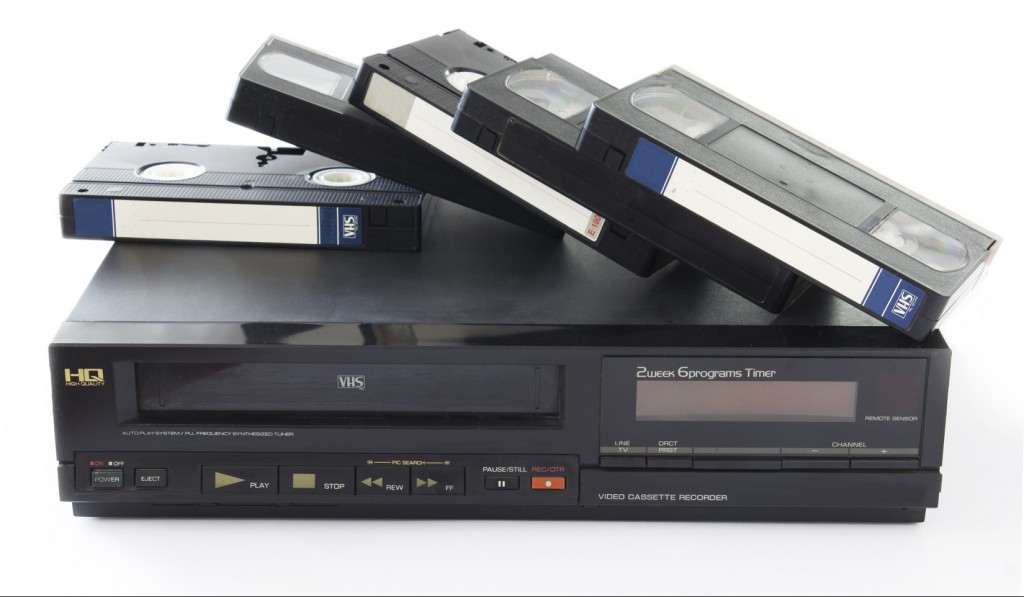
 VCR the official device of 1st birthday home videos and loud “coming soon to own on dvd & video” previews. VCR stands for videocassette recorder and was introduced to the world by JVC. VCR came about due to the demand in which people wanted to watch or rewatch movies without the need of leaving home and sitting down in a movie theater full of anonymous people. So in 1975 this ignited the famous “format war” which would be later called. This so called war was set between Sony’s Betamax (do not worry not a lot of people know what this is) and good old JVC’s VHS in the show of dominance over which format will people set as the standard in their living rooms. Even though Betamax had superior recording capability… that is all it had going for it, and to add salt to the wound, people could not even tell the difference between the quality of the recording. While on the other hand VHS had lengthier record times with its 2 hour recording or, if you do not mind colored static, 4 hour record times by degrading video quality. What really put nail in the coffin for Betamax was rental stores mostly stocking VHS tapes, yes rental stores... this is really showing this technology’s age. Due to tapes being quite expensive around $80-$90 in 1985, adjusted for inflation that is $186.50 to $209.45 in 2017! That what made people want to lean more towards rental of a movie due to them watching it once or twice anyways and not having to shell out $100 for a copy of The Karate Kid.
 VCR work similarly to how compact cassettes players work with the use of magnetic tapes. When a VHS is inserted the top plastic cover of the VHS would be removed exposing the where two adjustable guide rollers would guide the tape to the video drum head and the audio and tracker head. To prevent too much or too little of the tape to be fed to the head there are tension pins, supply guide pin, guide post, and pinch rollers to keep the tape running at a constant velocity. The most interesting part of this system is the orientation of the video drum head, it is slightly tilted because the magnetizable ferric oxide powder in the tape itself are slightly tilted in order to fit more movie in it. While in the other hand the audio track due to it running through another head is just straight line, nothing fancy going on with that.
Now VCRs are heavy black behemoth which are only used by hipsters or kept in closet due to better alternatives out there to enjoy a film. Video quality of a VCR in today's standard are truly awful, even in 1990s standard they were pretty bland, and if that was not enough the quality would degrade every time the tape is played because of those very same ferric oxide wearing out. VCR are much like an old board game like Monopoly, it spends most of it’s time shoved back behind a bunch of clothes and such, until one day, you get that urge to revisit it, to wind back to much simpler times in life.
FUN FACT: IN 2001 THERE WAS ENOUGH VHS TAPES MANUFACTURED TO GO FROM EARTH TO THE MOON 987 TIMES
source: https://en.wikipedia.org/wiki/VHS
https://en.wikipedia.org/wiki/Videocassette_recorder
https://allaboutmagnets.wikispaces.com/How+VHS+Tapes+Work
https://www.videomaker.com/article/f2/10509-fun-video-factoids

Guess I'm a hipster then. I love VHS tapes for so many reasons. I can hit up the thrift store or Rasputin and buy about 10 movies for the price of a single movie ticket. That's a steal! And plus, VHS is a good, cheap way to watch something before I decide I'd like to own it on a better format (Blade Runner??). And then there's that good ol' nostalgic feel of tapes: ain't no beating it.
ReplyDeleteI've always wanted to know the breakdown of how film work in a VCR, and you have clearly illuminated how complex and innovative these devices where for the time...Awesome!!!
ReplyDeleteEven though they are antiquated and certainly annoying to store, the memories of watching old cassettes as a child won't allow me to ever get rid of them. Nice post.
ReplyDelete