 Oh those big, black, boxy television or if you want to get scientific CRT, such fond memories most of us have of these things. Watching things such as Saturday morning cartoons, the news, or great movies, you know the ones, on those also big, black, boxy VHS with the equally big, black , boxy VCR that would be a chore to set up, having to rewind the tape and all and that's not even mentioning the anxiety one would get wondering if the VCR got a bit famished and decided to nibble on your favorite copy of The Little Rascals, but that's a blog for another day. Now CRT televisions were once a commonplace for many, but now the only people who have them are grandparents who say that they only need a flip phone, because “smartphones are too complicated.”
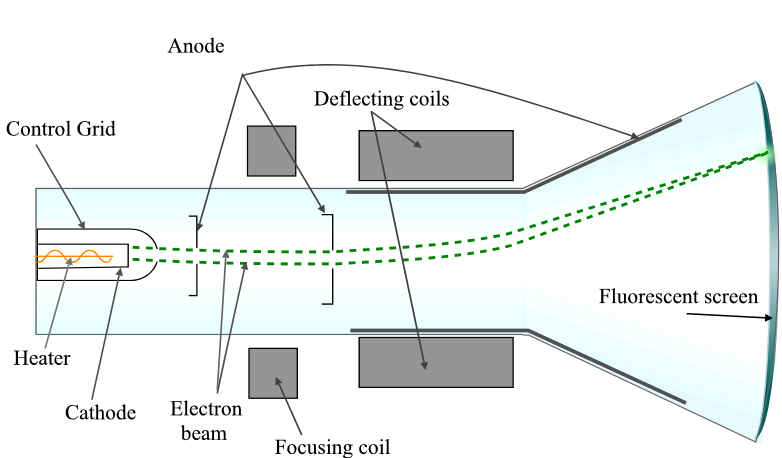
CRT stand for Cathode Ray Tube, and due to these cathode ray tubes is the reason why these televisions are so bulky. The technology behind this is very quite interesting. The majority of the CRT is a vacuum tube is which has one or three electron emitters (depending if it is a monochrome or color television) which as the name implies emits electrons onto a phosphorescent screen. The rays are manipulated by electrical coils, which create a magnetic fields to guide the beams of electrons in a raster, a.k.a from left to right from the top of the television to the bottom. That is the black bars that cameras pick up when looking at a CRT. The information that is sent to the beams are analog wave forms known as electrostatic deflections which bends the beams. To protect the user from most of the x-rays and prevent glass from shooting out when dropped or broken, thick lead glass is installed to prevent the user from getting injured. So in short the only thing stopping you from getting shot at by high intensity beams is a piece of glass made from lead. This is the reason why these things were such a pain to move, but of their seer weight and huge size. Not to mention that handling a CRT without a plastic cover exposes you to up to 25,000 volts of electricity and due to these televisions being so fragile that breaking a the vacuum seal is very possible exposing you to also very dangerous gases. So not only were CRT’s heavy to move around, they can also kill you in the process.
 Yet this design stuck around for more than 100 years. The first cathode ray tube was invented in 1897 by a German physicist named Karl Ferdinand Braun. That's not even mentioning people like Kenjiro Takayanagi who made it where CRT could receive images or Johann Hittorf who discovered cathode rays in 1869! CRT had a rich history and as later technological improvements allows T.V. set to get smaller, whereas the screen themselves gotten bigger, allowed the CRT to be relevant for as long as it did.
Now CRT are irrelevant due to modern LCD and OLED being cheaper, thinner, lighter, and more energy efficient. Now you can get a 72 inch LCD television and hang it on your wall with a CRT you can not even go that high. That does not mean that CRT are all bad, they tend to have better colors, better black levels and faster refresh rates. There is something special about having your face bombarded with electron beam that you can not get with modern television, or maybe that is the nostalgia talking.
↓This video gives you more insight on how images are produce on a CRT↓
FUN FACT: The TV remote became common with TVs in 1980s
source: https://en.wikipedia.org/wiki/Cathode_ray_tube
http://www.sciencekids.co.nz/sciencefacts/technology/television.html

I want a CRT tv again just to watch my VHS tapes on it. It's weird hooking up a VCR to an HD LCD television. It's not right. They're meant to be viewed on a beautifully crappy little tv.
ReplyDeleteI really enjoyed how you went into how these massive death and entertainment machines are made of as well as function. This is your most interesting piece yet and I am looking forward to what's next.
ReplyDeleteI never thought that I would be so interested in how a CRT television works, and yet here I am commenting back on a blog about it, after watching a YouTube video on how a CRT television works. I must say that I am very impressed with all the detail that was put into your blog. It was my first time reading it, and I'll definitely read again.
ReplyDelete